

FDA Approves Sarclisa Escena (isatuximab-irfc) Subcutaneous Injection for the Treatment of Multiple Myeloma
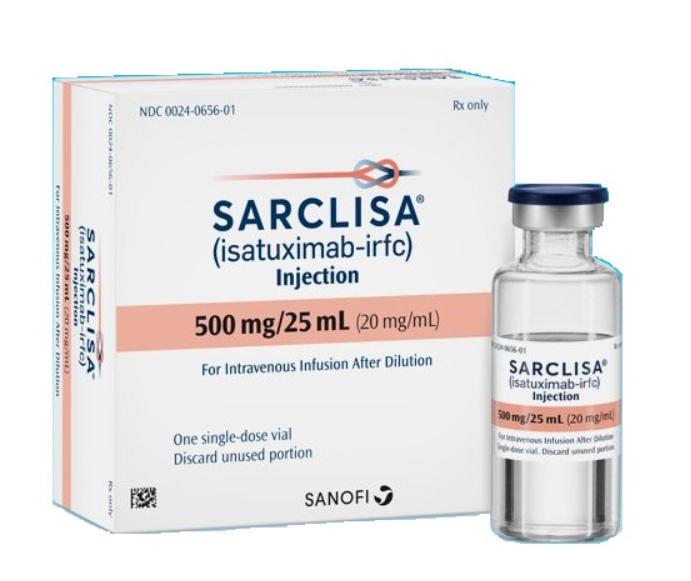
Paris, July 10, 2026. -- The US Food and Drug Administration (FDA) has approved subcutaneous (SC) Sarclisa (isatuximab-irfc) Escena in combination with standard-of-care regimens for the treatment of patients with multiple myeloma (MM) across all existing indications of Sarclisa intravenous (IV) formulation. With the approval, Sarclisa Escena is the first anticancer treatment to be administered through both an on-body injector (OBI) and manual SC administration.
- Sarclisa Escena administered via the CirCLIQ® on-body injector (OBI) offers a treatment experience designed with patients and HCPs in mind
- The first anticancer treatment to be administered through an OBI, and the first MM treatment available by both SC OBI and manual SC administration in the US
- Efficacy of Sarclisa now available in SC formulation with innovative OBI across approved combinations and lines of therapy
The FDA approval was supported by multiple studies, including the pivotal IRAKLIA phase 3 non-inferiority study, which demonstrated Sarclisa Escena administered subcutaneously via an OBI provided similar efficacy, pharmacokinetics and safety compared to IV infusion, along with a significantly shorter treatment time and fewer infusion-related reactions.
“Multiple myeloma is a malignancy that often requires frequent IV infusions or manual subcutaneous injections. Treatment administration can be a cumbersome experience for patients, while also placing a strain on providers by requiring physical effort to push high-resistance syringes for several minutes,” said Sikander Ailawadhi, MD, Professor of Medicine, Division of Hematology/Oncology at Mayo Clinic Florida, US, and the principal investigator of the IRAKLIA study. “The comparable efficacy observed across multiple studies and the patient-centric design of the OBI offers an opportunity to impact the patient experience while upholding Sarclisa’s consistent efficacy.”
The studies were conducted using Enable Injections’ hands-free OBI, an automated injector designed to deliver subcutaneously high-volume medicines with the push of a button, to administer Sarclisa Escena. The OBI uses a retractable 30g needle that is shorter and thinner compared to the needles commonly used for large-volume injections. The approval of Sarclisa Escena with Enable Injections’ CirCLIQ OBI – developed using the enFuse® platform – offers the potential to change the overall patient experience in MM treatment.
“Sarclisa is the cornerstone of our oncology franchise, and we have always been confident in it being widely adopted as a potential best-in-class therapy,” said Manuela Buxo, Executive Vice President, Head of Specialty Care at Sanofi. “The approval of Sarclisa Escena subcutaneous formulation administered with the CirCLIQ is a definitive step in this direction. More than 70,000 patients worldwide have benefitted from Sarclisa, delivering predictable and important efficacy and safety across multiple combinations and lines of therapy. Today, we are proud to bring innovation that will empower physicians to enhance the treatment experience for patients, offering greater simplicity, flexibility and convenience.”
In addition, the CirCLIQ may streamline the administration process for providers, offering the potential to reduce the physical burden on nurses with a hands-free device and providing more freedom for patient monitoring and interaction.
“The introduction of Sarclisa Escena with the innovative CirCLIQ on-body injector represents a significant advancement in multiple myeloma care,” said Donna D. Catamero, ANP-BC, OCN, CCRC, Associate Director, Myeloma Research; Adjunct Faculty, Mount Sinai Phillips School of Nursing and International Myeloma Foundation Nurse Leadership Board member. “For nurses and physicians treating patients with multiple myeloma, this automated system has the potential to meaningfully reduce administrative burden, simplifying how therapy is delivered and giving healthcare teams more capacity to focus on their patients.”
In the IRAKLIA phase 3 study, the first to incorporate the use of an OBI in the treatment of MM, Sarclisa SC administered via an OBI in combination with pomalidomide and dexamethasone (Pd) resulted in a 71.1% (187/263) objective response rate (ORR), compared to 70.5% (189/268) with Sarclisa IV-Pd, establishing non-inferiority (relative risk 1.008; 95% confidence interval: 0.903-1.126), in adult patients with relapsed or refractory MM (R/R MM) who have received at least one prior line of treatment.
The overall safety profile of Sarclisa SC-Pd observed in this study was consistent with the established safety profile of Sarclisa IV-Pd. While 25% of patients treated with Sarclisa IV-Pd experienced systemic administration reactions, 1.5% of patients treated with Sarclisa SC-Pd experienced those reactions. No new safety concerns were observed, except for injection site reactions (ISRs) that occurred in 0.4% of OBI injections (n=19/5,145 injections). Nearly all ISRs were grade 1, except for one episode of grade 2.
The most common adverse reactions (≥20%) were upper respiratory tract infection, fatigue, pneumonia, musculoskeletal pain, and diarrhea. The most common hematology laboratory abnormalities (≥40%) were decreased leukocytes, decreased neutrophils, decreased lymphocytes, decreased platelets, and decreased hemoglobin.
Sarclisa is currently approved across three indications in the US, including in combination with bortezomib, lenalidomide and dexamethasone in newly diagnosed multiple myeloma (NDMM) patients not eligible for autologous stem cell transplant. In R/R MM, Sarclisa is approved in combination with Pd in patients who have received ≥two prior therapies, including lenalidomide and a proteasome inhibitor and have relapsed on the last therapy, as well as in combination with carfilzomib and dexamethasone in patients who have received one to three prior lines of therapy.
About the IRAKLIA study
IRAKLIA (clinical study identifier: NCT05405166) was a randomized, open-label, pivotal phase 3 study evaluating the non-inferiority of Sarclisa Escena administered at a fixed dose of 1,400 mg SC in combination with Pd via OBI versus weight-based dosed Sarclisa IV in combination with Pd in adult patients with R/R MM who have received at least one prior line of therapy. The major efficacy measures were ORR, defined as the proportion of patients with stringent complete response (CR), CR, very good partial response, and partial response according to the 2016 International Myeloma Working Group criteria assessed by Independent Review Committee, and observed Sarclisa Escena mean concentration before dosing (Ctrough) at steady state (pre-dose at cycle 6, dose 1 [C6D1]), defined as observed Sarclisa Escena plasma concentrations.
About Enable Injections
Cincinnati-based Enable Injections is a global healthcare innovation company committed to improving the patient treatment experience through the development and manufacturing of the enFuse® On-Body Delivery System. An innovative wearable technology, the enFuse system is designed to deliver large volumes of pharmaceutical and biologic therapeutics via subcutaneous administration, with the aim of improving convenience, supporting superior outcomes, and advancing healthcare system economics.
For more information, visit www.enableinjections.com.
About Sarclisa
Sarclisa (isatuximab-irfc) has been approved in almost 60 countries across four indications for certain patients with NDMM and R/R MM.
Sarclisa-based regimens have been prescribed to treat more than 70,000 patients worldwide.
Sarclisa SC (Sarclisa Escena in the US), the subcutaneous formulation of Sarclisa, is approved in the US, in the EU, and in the UK, in combination with approved standard-of-care regimens for the treatment of patients with MM across all currently approved indications for Sarclisa IV in these countries. It is the first anticancer treatment to be administered through an OBI, and the only anti-CD38 monoclonal antibody available in MM to offer the flexibility of both SC OBI and manual injection administration. Sarclisa SC is approved in Japan for manual injection and a regulatory submission for the CirCLIQ on body injector (OBI), based on the enFuse platform and submitted by Enable Injections, is under review.
At Sanofi, we are building on a long-standing commitment to oncology as we continue to chase the miracles of science to improve the lives of those living with cancer. We are committed to transforming cancer care by developing innovative, first and best-in-class immunological and targeted therapies for rare and difficult-to-treat cancers with high unmet need.
For more information on Sarclisa clinical studies, please visit www.clinicaltrials.gov.
What is Sarclisa?
Sarclisa is a prescription medicine used in combination with:
- The medicines pomalidomide and dexamethasone, to treat adults who have received at least 2 prior therapies including lenalidomide and a proteasome inhibitor to treat multiple myeloma.
- The medicines carfilzomib and dexamethasone, to treat adults with multiple myeloma who have already received 1 to 3 lines of treatment, and they did not work or are no longer working.
- The medicines bortezomib, lenalidomide, and dexamethasone, to treat adults with newly diagnosed multiple myeloma who cannot receive a type of stem cell transplant that uses their own stem cells (autologous stem cell transplant).
What is Sarclisa Escena?
Sarclisa Escena is a prescription medicine used in combination with:
- The medicines pomalidomide and dexamethasone, to treat adults who have received at least 1 prior line of therapy including lenalidomide and a proteasome inhibitor to treat multiple myeloma.
- The medicines carfilzomib and dexamethasone, to treat adults with multiple myeloma who have already received 1 to 3 lines of treatment, and they did not work or are no longer working.
- The medicines bortezomib, lenalidomide, and dexamethasone, to treat adults with newly diagnosed multiple myeloma who cannot receive a type of stem cell transplant that uses their own stem cells (autologous stem cell transplant).
It is not known if Sarclisa or Sarclisa Escena are safe and effective in children.
Important Safety Information
Do not receive Sarclisa or Sarclisa Escena if you have a severe allergic reaction to isatuximab-irfc or any of the ingredients in Sarclisa or Sarclisa Escena (see the list of ingredients in the full Prescribing Information for Sarclisa and Sarclisa Escena).
Before you receive Sarclisa or Sarclisa Escena, tell your healthcare provider about all of your medical conditions, including if you:
- Have an infection.
- Have heart problems, if your healthcare provider prescribes Sarclisa or Sarclisa Escena in combination with carfilzomib and dexamethasone for you.
- Have had shingles (herpes zoster).
- Are pregnant or plan to become pregnant. Sarclisa and Sarclisa Escena can harm your unborn baby.
Females who are able to become pregnant:
- Your healthcare provider will check for pregnancy before you start treatment with Sarclisa or Sarclisa Escena.
- Use an effective birth control (contraception) during treatment and for 5 months after your last dose of Sarclisa or for 7 months after your last dose of Sarclisa Escena. Talk to your healthcare provider about birth control methods that you can use during this time.
- Tell your healthcare provider right away if you think you are pregnant or become pregnant during treatment with Sarclisa or Sarclisa Escena.
Females and males: Before receiving Sarclisa or Sarclisa Escena in combination with either pomalidomide or lenalidomide, females and males must agree to the instructions in the pomalidomide or lenalidomide REMS programs. The pomalidomide and lenalidomide REMS programs have specific requirements about birth control, pregnancy testing, blood donation, and sperm donation that you need to know. Talk to your healthcare provider to learn more about pomalidomide or lenalidomide.
- Are breastfeeding or plan to breastfeed. It is not known if Sarclisa or Sarclisa Escena pass into your breast milk. Do not breastfeed during treatment with Sarclisa. Do not breastfeed during treatment with Sarclisa Escena and for 7 months after your last dose.
Tell your healthcare provider about all the medicines you take, including prescription and over-the-counter medicines, vitamins, and herbal supplements.
How will I receive Sarclisa?
- Sarclisa will be given to you by your healthcare provider by intravenous (IV) infusion into your vein.
- Sarclisa in combination with pomalidomide and dexamethasone, or Sarclisa in combination with carfilzomib and dexamethasone is given in treatment cycles of 28 days (4 weeks).
- Cycle 1 (28-day cycle), Sarclisa is given weekly.
- Cycle 2 and beyond (28-day cycles), Sarclisa is given every 2 weeks.
- Sarclisa in combination with bortezomib, lenalidomide, and dexamethasone is given in treatment cycles of 42 days (6 weeks) from cycle 1 to 4 and in treatment cycles of 28 days (4 weeks) from cycle 5.
- Cycle 1 (42-day cycle), Sarclisa is given weekly (Days 1, 8, 15, 22, and 29).
- Cycles 2 to 4 (42-day cycles), Sarclisa is given every 2 weeks (Days 1, 15, and 29).
- Cycles 5 to 17 (28-day cycles), Sarclisa is given every 2 weeks (Days 1 and 15).
- Cycles 18 and beyond (28-day cycles), Sarclisa is given every 4 weeks.
- Your healthcare provider will decide how many treatments you will receive.
- Your healthcare provider will give you medicines before each infusion of Sarclisa to help reduce the risk of infusion reactions (make them less frequent and severe).
- If you miss any appointments, call your healthcare provider as soon as possible to reschedule your appointment.
How will I receive Sarclisa Escena?
- Sarclisa Escena will be given to you by your healthcare provider as an injection under the skin (subcutaneous injection) in the stomach area (abdomen). Your healthcare provider will either use the CirCLIQTM On-Body Injector or a syringe to inject Sarclisa Escena. Your healthcare provider will rotate the injection site for each injection, including for other medicines.
- Sarclisa Escena in combination with pomalidomide and dexamethasone, or Sarclisa Escena in combination with carfilzomib and dexamethasone is given in treatment cycles of 28 days (4 weeks).
- Cycle 1 (28-day cycle), Sarclisa Escena is given weekly.
- Cycle 2 and beyond (28-day cycles), Sarclisa Escena is given every 2 weeks.
- Sarclisa Escena in combination with bortezomib, lenalidomide, and dexamethasone is given in treatment cycles of 28 days (4 weeks).
- Cycle 1 (28-day cycle), Sarclisa Escena is given weekly.
- Cycles 2 to 12 (28-day cycles), Sarclisa Escena is given every 2 weeks.
- Cycles 13 and beyond, Sarclisa Escena is given every 4 weeks.
- Your healthcare provider will decide how many treatments you will receive.
- Your healthcare provider will give you medicines before each injection of Sarclisa Escena, to help reduce the risk and severity of allergic reactions, for at least Cycle 1 of treatment.
- If you miss any appointments, call your healthcare provider as soon as possible to reschedule your appointment.
What are the possible side effects of Sarclisa?
Sarclisa may cause serious side effects, including:
• Infusion reactions. Infusion reactions are common with Sarclisa and can sometimes be severe or life threatening.
- Your healthcare provider will prescribe medicines before each infusion of Sarclisa to help decrease your risk for infusion reactions or to help make any infusion reaction less severe. You will be monitored for infusion reactions during each infusion of Sarclisa.
- Your healthcare provider may slow down or stop your infusion, or completely stop treatment with Sarclisa if you have an infusion reaction.
Get medical help right away if you develop any of the following symptoms of infusion reaction during or after an infusion of Sarclisa:
|
|
• Infections. Sarclisa can cause infections that are severe, life-threatening, or that may lead to death. Your healthcare provider will monitor you for signs and symptoms of infection before and during treatment with Sarclisa. Your healthcare provider may prescribe medicines for you to help prevent infections and treat you as needed if you develop an infection during treatment with Sarclisa. Tell your healthcare provider right away if you develop a fever or any signs or symptoms of infection during treatment with Sarclisa.
- Decreased white blood cell counts. Decreased white blood cell counts are common with Sarclisa and certain white blood cells can be severely decreased. Fever can occur with low white blood cell counts and may be a sign that you have an infection. Your healthcare provider will check your blood cell counts during treatment with Sarclisa and may prescribe a medicine to help increase your white blood cell counts. Tell your healthcare provider right away if you develop any fever or symptoms of infection during treatment with Sarclisa.
• Risk of new cancers. New cancers have happened in people during and after treatment with Sarclisa. Your healthcare provider will monitor you for new cancers during treatment with Sarclisa.
• Change in blood tests. Sarclisa may affect the results of blood tests to match your blood type for about 6 months after your last infusion of Sarclisa. Your healthcare provider will do blood tests to match your blood type before you start treatment with Sarclisa. Tell all of your healthcare providers that you are being treated with Sarclisa before receiving blood transfusions.
The most common side effects of Sarclisa in combination with pomalidomide and dexamethasone include:
- upper respiratory tract infection
- lung infection (pneumonia)
- diarrhea
- decreased red blood cell count (anemia)
- decreased platelet count (thrombocytopenia)
The most common side effects of Sarclisa in combination with carfilzomib and dexamethasone include:
|
|
The most common side effects of Sarclisa in combination with bortezomib, lenalidomide and dexamethasone include:
|
|
Heart failure can happen during treatment with Sarclisa in combination with carfilzomib and dexamethasone. Tell your healthcare provider right away if you develop any of the following symptoms:
- trouble breathing
- cough
- swelling of your ankles, feet, or legs
These are not all the possible side effects of Sarclisa. For more information, ask your healthcare provider or pharmacist.
What are the possible side effects of Sarclisa Escena?
Sarclisa Escena can cause serious side effects, including:
• Allergic reactions. Sarclisa Escena can cause severe or life-threatening allergic reactions throughout the body (systemic administration reactions). Your healthcare provider may stop your injection and not complete it or completely stop treatment with Sarclisa Escena if you have an allergic reaction. Tell your healthcare provider or get medical help right away if you develop any of the following signs and symptoms of an allergic reaction, including:
|
|
• Injection site reactions can happen at or near the Sarclisa Escena injection site. Symptoms of these local skin reactions include redness, swelling, and pain. Tell your healthcare provider if you develop injection site reactions during treatment with Sarclisa Escena.
• Decreased white blood cell counts. Decreased white blood cell counts are common and can be severe during treatment with Sarclisa Escena. If fever occurs, this may be a sign that you have an infection. Your healthcare provider will check your blood cell counts during treatment with Sarclisa Escena and may prescribe medicine to help increase your white blood cell counts. Tell your healthcare provider right away if you develop any fever or symptoms of infection during treatment with Sarclisa Escena.
• Infections. Sarclisa Escena can cause infections that are severe, life-threatening, or that can lead to death. Your healthcare provider will monitor you for signs and symptoms of infection before and during treatment with Sarclisa Escena. Your healthcare provider may prescribe medicines for you to help prevent infections and treat you as needed if you develop an infection during treatment with Sarclisa Escena. Tell your healthcare provider right away if you develop a fever or any signs or symptoms of infection during treatment with Sarclisa Escena.
• Risk of new cancers. New cancers have happened in people during treatment with Sarclisa Escena. Your healthcare provider will monitor you for new cancers during treatment with Sarclisa Escena.
• Change in blood tests. Sarclisa Escena may affect the results of blood tests to match your blood type for at least 6 months after your last injection of Sarclisa Escena. Your healthcare provider will do blood tests to match your blood type before you start treatment with Sarclisa Escena. Tell all of your healthcare providers that you are being treated with Sarclisa Escena before receiving blood transfusions.
The most common side effects of Sarclisa Escena in combination with pomalidomide and dexamethasone include:
|
|
The most common side effects of Sarclisa Escena in combination with carfilzomib and dexamethasone include:
|
|
The most common side effects of Sarclisa Escena in combination with bortezomib, lenalidomide, and dexamethasone include:
|
|
The most common abnormal blood test results during treatment with Sarclisa Escena combination therapies include:
|
|
|
Heart failure can happen during treatment with Sarclisa Escena in combination with carfilzomib and dexamethasone. Tell your healthcare provider right away if you develop any of the following symptoms:
|
|
|
These are not all of the possible side effects of Sarclisa Escena. For more information, ask your healthcare provider or pharmacist.
Call your doctor for medical advice about side effects. You are encouraged to report negative side effects of prescription drugs to the FDA. Visit www.fda.gov/medwatch, or call 1-800-FDA-1088.
About Sanofi
Sanofi is an R&D driven, AI-powered biopharma company committed to improving people’s lives and delivering compelling growth. We apply our deep understanding of the immune system to invent medicines and vaccines that treat and protect millions of people around the world, with an innovative pipeline that could benefit millions more. Our team is guided by one purpose: we chase the miracles of science to improve people’s lives; this inspires us to drive progress and deliver positive impact for our people and the communities we serve, by addressing the most urgent healthcare, environmental, and societal challenges of our time.
Sanofi is listed on EURONEXT: SAN and NASDAQ: SNY
Sanofi forward-looking statements
This press release contains forward-looking statements within the meaning of applicable securities laws, including the Private Securities Litigation Reform Act of 1995, as amended.
Forward-looking statements are statements that are not historical facts. These statements include projections and estimates and their underlying assumptions regarding the marketing and other potential of the product; regarding potential future events and revenues from the product. Words such as “expect,” “anticipate,” “believe,” “intend,” “estimate,” “plan,” “can,” “contemplate,” “could,” “is designed to,” “may,” “might,” “potential,” “objective,” "attempt," “target,” “project,” "strategy," "strive," "desire," “predict,” “forecast,” “ambition,” “guideline,” "seek," “should,” “will,” "goal," or the negative of these and similar expressions are intended to identify forward-looking statements.
Although Sanofi’s management believes that the expectations reflected in such forward-looking statements are reasonable, investors are cautioned that forward-looking information and statements are subject to various risks and uncertainties, many of which are difficult to predict and generally beyond the control of Sanofi, that could cause actual results and developments to differ materially from those expressed in, or implied or projected by, the forward-looking information and statements. These risks, uncertainties and assumptions include among other things, unexpected regulatory actions or delays, or government regulation generally, that could affect the availability or commercial potential of the product, the fact that product may not be commercially successful; authorities’ decisions regarding whether and when to approve a product candidate; political pressure in the United States to mandate lower drug prices including “most favored nation” pricing for State Medicaid programs; the uncertainties inherent in research and development, including future clinical data and analysis of existing clinical data relating to the product, including post marketing, unexpected safety, quality or manufacturing issues; competition in general; risks associated with intellectual property and any related pending or future litigation and the ultimate outcome of such litigation, and volatile economic and market conditions, and the impact that global crises may have on us, our customers, suppliers, vendors, and other business partners, and the financial condition of any one of them, as well as on our employees and on the global economy as a whole. The risks and uncertainties also include the uncertainties discussed or identified in the public filings with the SEC and the French Markets Authority (AMF) made by Sanofi, including those listed under “Risk Factors” and “Cautionary Statement Regarding Forward-Looking Statements” in Sanofi’s annual report on Form 20-F for the year ended December 31, 2025 or contained in our periodic reports on Form 6-K. Other than as required by applicable law, Sanofi does not undertake any obligation to update or revise any forward-looking information or statements. In light of these risks, uncertainties and assumptions, you should not place undue reliance on any forward-looking statements contained herein.
All trademarks mentioned in this press release are the property of the Sanofi group with the exception of enFuse and CirCLIQ.
Source: Sanofi